

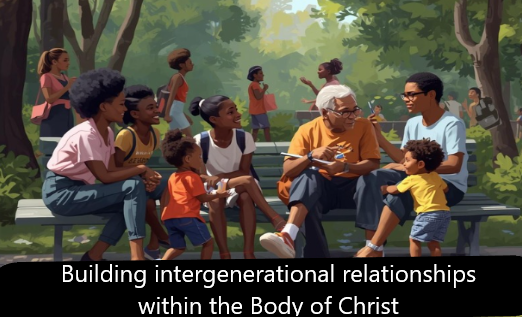
Building intergenerational relationships within the Body of Christ (Part 1)
Good morning brethren, I would like to write on the topic “Building intergenerational relationships within the Body of Christ – Part One.” What does this phrase mean Intergenerational relationships refer to meaningful connections between people of different age groups—children, teenagers, youth, young adults, and older adults. The “Body of Christ” refers to the Christian community or Church, where all believers are spiritually united as one body. Therefore, building intergenerational relationships means intentionally fostering strong, meaningful connections across all age groups within the Church. This concept is not designed to segregate people into categories, but to bring them together in a biblically balanced and spiritually healthy way.
The Church was never intended to function in isolation by age groups. Rather, the Bible reveals a pattern of generations walking together in faith, instruction, and service. God’s Word shows us that generations need one another. For example, Psalm 78:4–7 declares “We will not hide them from their children, showing to the generation to come the praises of the Lord… that the generation to come might know them, even the children which should be born.” Faith is meant to be passed on, Psalm 145:4 reinforces this truth “One generation shall praise thy works to another, and shall declare thy mighty acts.” God designed generational continuity—not generational separation. We are also warned in Judges 2:10 “There arose another generation after them, which knew not the Lord.” This is what happens when the baton of faith is not properly passed—spiritual decline follows. Judges 2:11 shows the consequence: the next generation turned to idols. Let it be clearly stated: no matter how successful one generation may appear, if it fails to transfer faith, it has ultimately failed in its assignment. May our generation not fail, in Jesus name. Unfortunately, in many of our Churches today, there is little provision for succession or continuity. Some departments function within a single-generation structure, lacking intentional integration with other age groups. There is a clear need for a deliberate intergenerational structure. If this structure is not clearly communicated or intentionally demonstrated, especially to the younger generation, the result is often disengagement, withdrawal, or separation. Building intergenerational relationships involves older believers intentionally mentoring younger ones, younger believers looking up to older ones as godly examples, serving side by side in ministry and creating partnerships that foster spiritual growth. Practical examples include experienced ushers guiding newer members, senior leaders mentoring emerging leaders, and pastors sharing wisdom with younger ministers.
As I conclude Part One of this topic, it is important to note that depending on your country of operation, due diligence must be observed. When developing and implementing your vision, ensure that appropriate measures are in place. This is important to avoid mistakes especially as the older generation mentors the younger generation. For example, in the United Kingdom, it is essential to uphold child protection policies, including proper safeguarding procedures and background checks. Service begins at 10:30am, and the workers meeting is at 10:00am, God’s blessings - Mike