

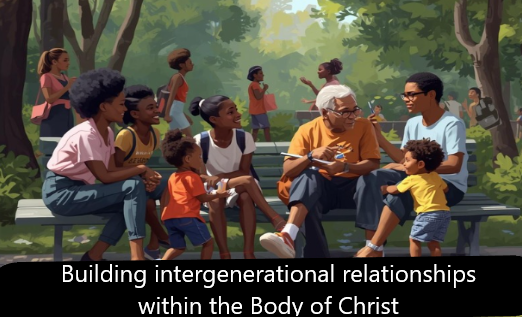
Building intergenerational relationships within the body of Christ - Part 2
Good morning brethren, I would like to continue writing on the topic: “Building intergenerational relationships within the body of Christ – part two.” To briefly recap Part One: I defined intergenerational relationships as meaningful connections between people of different age groups including children, teenagers, youth, young adults, and older adults. While the Body of Christ refers to the Christian community or Church, where all believers are spiritually united as one body. Bringing these together, I described intergenerational relationships as the intentional fostering of strong, meaningful connections across all age groups within the Church, with the aim of nurturing a biblically balanced and spiritually healthy community. We reflected on Psalm 78:4–7, which reminds us not to hide the works of God from future generations, but to declare His praises so that those yet to be born may know Him. This establishes a pattern of generations walking together in faith, instruction, and service. We also highlighted that God’s design is for generational continuity, not separation (Psalm 145:4). Where this is neglected, the consequence is seen in Judges 2:10–11, where a generation arose that did not know the Lord which lead to spiritual decline.
Moving into Part two, I would like to further explore how Jesus modelled intergenerational ministry, and how the Early Church embodied this relationship. In Matthew 19:14, Jesus said, “Suffer little children… to come unto Me: for of such is the kingdom of heaven.” This teaches us that children are not merely future members of the Church, they are also present participants in the Kingdom. They must be given opportunities to engage, contribute, and be involved. Similarly, Psalm 8:2 declares, “Out of the mouth of babes and sucklings hast thou ordained strength.” This reveals that strength is not limited by age. It challenges the assumption that wisdom and spiritual authority flow only from older to younger. Instead, it shows that God works through the young as well and they can teach, inspire, and even correct. This highlights an important truth that intergenerational relationships should not be one-directional. Rather than a model where elders only teach and youth only receive or listen, Scripture points to a reciprocal relationship. Older generations bring experience, stability, and guidance, while younger generations bring freshness, honesty, faith, and perspective. Both are essential for a complete expression of strength in the Church. It is also worth noting that infants represent vulnerability and dependence. Yet God ordains strength through them which reveals that true strength is rooted in humility and openness, not merely competence. This calls older believers to remain teachable, while encouraging younger individuals to recognise their value even before they gain status. Too often, younger voices are dismissed or sidelined in our churches, families, and communities. But if God chooses to speak through the young, ignoring them means missing out on something He is doing. We must therefore create space for their involvement—inviting them into decision-making, listening seriously to their insights, and fostering genuine dialogue. As we speak about “passing the baton,” it is important to understand that the presence of younger generations does not only secure the future, but also actively shapes the present. Their faith, questions, and perspectives refine and strengthen the older generation as well. Jesus Himself demonstrated this by discipling the twelve disciples—many of whom were young men. He intentionally invested in them so they could carry the Gospel forward. This shows that mentorship across generations is central to Kingdom advancement. The Early Church also modelled this through what we may call an apostolic pattern of mentorship. The Apostle Paul invested in younger leaders such as Timothy (Acts 16:1–5) and John Mark (Acts 12; 13:1–5). He also instructed older believers to teach and model godly living to the younger generation (Titus 2:1–8). In 1 Timothy 4:12, Paul encourages young leaders “Let no man despise thy youth; but be thou an example…” This reinforces the truth that both young and old have vital roles to play in the Church.
In conclusion, the older generation brings wisdom, faithfulness, and stability, while the younger generation brings zeal, energy, and fresh faith. Together, they form a complete, healthy, and thriving Church. I hope this second part helps to remove fears, hesitation, or the concern that younger generations are seeking to “take over.” Instead, we should see this as a divine partnership, one that reflects God’s design for His Church. Happy Easter to everyone, our service starts at 10:30am, and the worker’s meeting will be at 10:00am. God’s blessings - Mike